
Links on this page go to Amazon. As an Amazon Associate, techinterview.org may earn from qualifying purchases. Prices change often, so we show price ranges only; check the product page for today’s price.
A USB microphone fixes the thing interviewers notice first: a thin, roomy laptop voice that gets worse every time a neighbor's door closes. In a small apartment with no acoustic treatment, the spec that matters most is not sample rate but capsule type. A dynamic cardioid mic hears what is a few inches in front of it and little else, which is exactly what a compressed Zoom call needs.
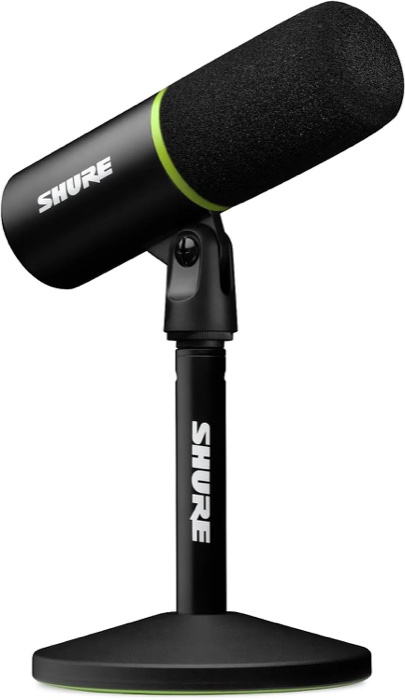
Shure MV6 USB Gaming Microphone
Engineers who want one plug-in mic that sounds professional from a normal desk distance without any fiddling.
Why we picked it. The MV6 pairs a dynamic capsule with Shure's on-board processing, and reviewers agree that combination is what makes it work in a small room. Trusted Reviews called its noise rejection some of the best from any USB microphone and said it isolated the voice with music playing; MusicRadar got near noise-free recordings with a loud computer fan running. PC Gamer found the auto-level mode reacts instantly, so you can leave the mic a foot away and out of the shot instead of leaning into it, and Trusted Reviews had it recognised at once on Windows and macOS. A metal desk stand, a USB-C cable and a tap-to-mute pad are included.
Flaws but not dealbreakers. PC Gamer found the built-in noise reduction is an on-or-off switch that can add a slightly washy quality to some voices, and the included cable is only one metre long. The stand's base is heavy and takes up desk space. There is no XLR output and no physical gain knob; adjustments live in the MOTIV Mix app, which Trusted Reviews called limited.
| capsule | Dynamic, cardioid |
|---|---|
| frequency_response | 50 Hz to 15 kHz |
| connection | USB-C, 16 or 24-bit at 44.1 or 48 kHz, bus powered; 3.5 mm headphone out |
| size_weight | 51 x 169 x 127 mm on its stand, about 1.29 kg with stand |
| in_the_box | Mic, 1 m USB-C to USB-C cable, 12 cm round-base desktop stand |
| controls | Tap-to-mute pad on top; gain, tone and denoiser in the free MOTIV Mix app |
See on Amazon →availability and price range checked September 2026
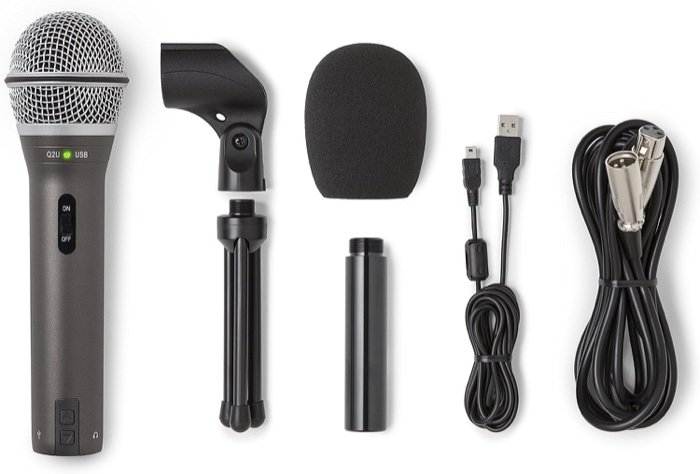
Samson Q2U USB/XLR Dynamic Microphone Recording and Podcasting Pack
The cheapest mic that is clearly better than a laptop and still looks like a normal microphone on camera.
Why we picked it. The Q2U is a handheld dynamic mic that has been the default beginner podcast pick for years, and the reasons carry over to interviews. The Podcast Host, which rates it 4.9 out of 5, says the cardioid dynamic capsule rejects much of the sound around and behind it and handles bumps better than many rivals; Buzzsprout says it ignores ambient noise in untreated rooms where a condenser would not. The box has a tripod stand, foam windscreen, USB and XLR cables, and the mic has a headphone jack and a physical on-off switch. It is class compliant on Mac, Windows and Chromebook with no driver.
Flaws but not dealbreakers. Reviewers note it is sensitive to plosives, so keep the foam windscreen on and speak across the mic rather than into it. The tripod stand is light and sits low, so a taller desk stand or a cheap boom arm is a common first add-on. USB output is 16-bit, which is fine for calls. Older units used micro-USB; Samson's current spec sheet lists USB-C.
| capsule | Dynamic, cardioid |
|---|---|
| frequency_response | 50 Hz to 15 kHz |
| connection | USB (class compliant, up to 16-bit at 44.1 or 48 kHz) plus XLR; 3.5 mm headphone out |
| size_weight | 190 x 55 mm, 0.32 kg |
| in_the_box | Mic clip, tripod stand with extension, foam windscreen, 2.25 m USB cable, 3 m XLR cable |
| controls | Physical on/off switch on the body |
See on Amazon →availability and price range checked September 2026
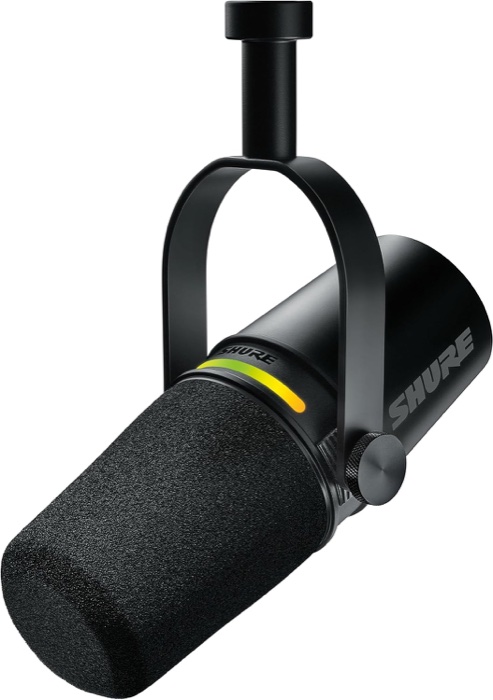
Shure MV7+ USB-C & XLR Podcast Dynamic Microphone (Black)
People who are on calls all day and want broadcast tone, a big visible mute, and room to grow.
Why we picked it. The MV7+ is the same idea as the MV6 with a warmer SM7-style voice, an XLR output for later, and more processing. Tom's Guide played cafe chatter behind a reading and found the recording clear with only faint residue in the pauses, far cleaner than the same take without the denoiser. The Podcast Host measured the auto-level mode landing at a healthy minus 24 LUFS without touching a gain knob, and MicroPicked reported keyboard clicks at two feet and HVAC hum reduced to inaudible. The LED touch panel is a large mute you can hit without looking, and a foam windscreen and a three-metre USB-C cable are included.
Flaws but not dealbreakers. No stand or boom arm is in the box, and Tom's Guide found the digital pop filter weaker than the denoiser. The Podcast Host needed a direct USB-C port; a USB-A adapter caused problems. MicroPicked reports the app occasionally losing its connection to the mic mid-session. It is the most expensive option here, and the processing only works over USB, not XLR.
| capsule | Dynamic, cardioid |
|---|---|
| frequency_response | 50 Hz to 16 kHz |
| connection | USB-C at 24-bit/48 kHz plus XLR; 3.5 mm headphone out |
| size_weight | About 0.55 kg without a stand; needs a boom arm or a separate desk stand |
| in_the_box | Mic, foam windscreen, 3 m USB-C to USB-C cable; no stand |
| controls | LED touch panel for mute and level; denoiser, auto level, pop filter and reverb in MOTIV Mix |
See on Amazon →availability and price range checked September 2026
How to choose
Buy a dynamic microphone with a cardioid pattern and a USB-C output, and make sure a desk stand is in the box. Dynamic capsules are far less sensitive than the condensers inside the Blue Yeti, Rode NT-USB Mini and Elgato Wave:3, so a fridge compressor, street traffic, or a roommate in the next room mostly disappears before any software gets involved. Ignore multi-pattern switches, RGB lighting, 96 kHz sample rates and XLR outputs; Zoom and Meet compress everything to a narrow band and none of that survives the call. Software noise removal helps with steady hum but not with keyboard clatter, so still learn where your mute key is. The common mistake is buying a sensitive condenser because it looks like a studio mic, then wondering why every call sounds like it was recorded in a bathroom.
Put the mic on its stand just below the bottom edge of the frame, four to eight inches from your mouth and slightly to one side so it does not cover your face, and talk across the top of it rather than straight into it. Mute yourself while the interviewer reads out a long problem statement.
Also considered
- FIFINE AmpliGame AM8 USB/XLR Dynamic Microphone Cheaper than the Q2U and TechPowerUp found it very deaf to keyboard and off-axis noise, but the RGB ring and a wobbly desk mount that Podcastage flagged make it look and behave like a gaming peripheral on camera.
- Rode PodMic USB TechRadar praised the build and its handling of ambient noise and knocks, but at 900 g with no stand in the box you must also buy a boom arm, and its mid-heavy tone needs EQ before it sounds right.
Useful next steps:
